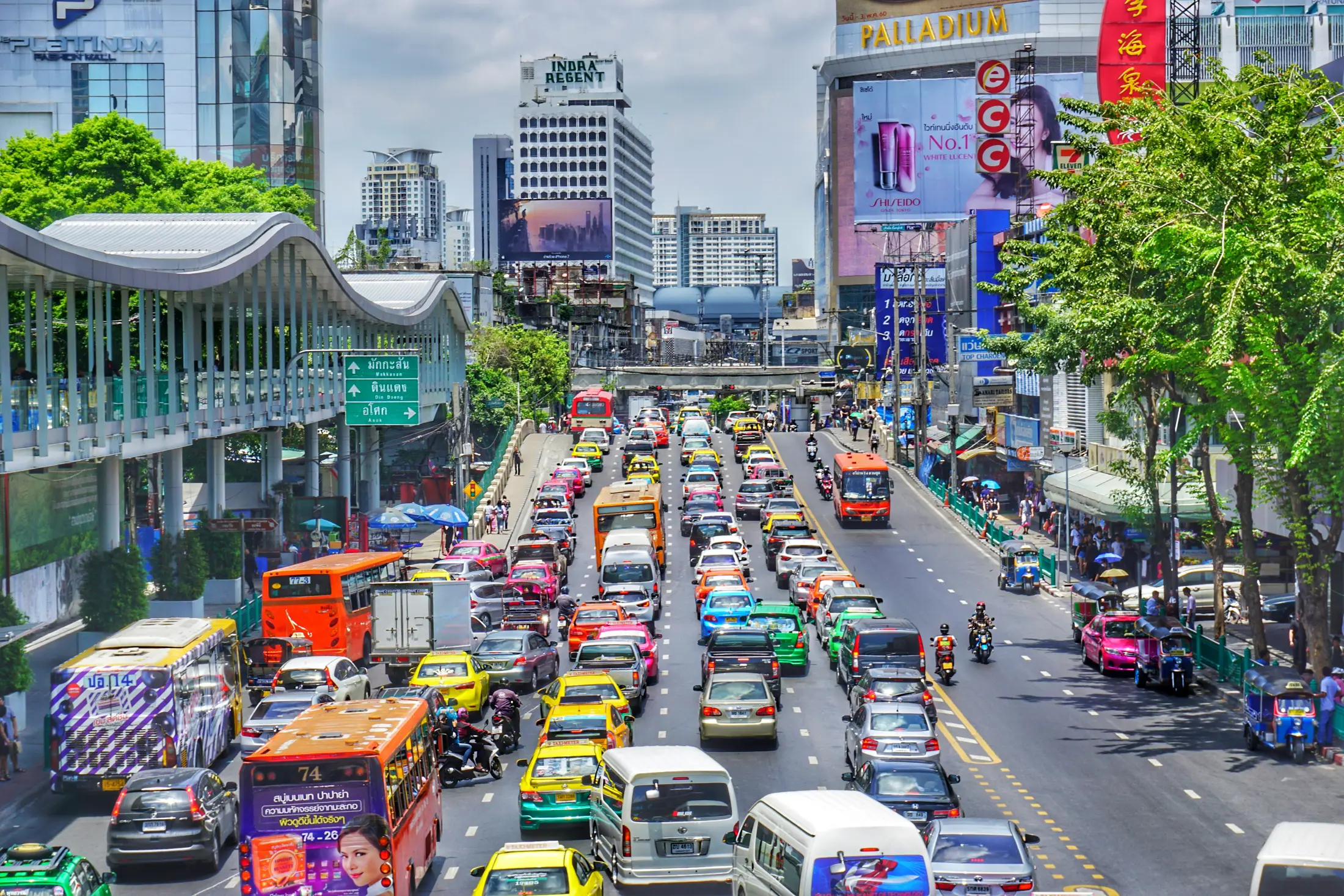

The Airport Rail Link has one enormous advantage over a taxi.
Bangkok traffic does not matter.
The City Line runs from Suvarnabhumi Airport to Phaya Thai, stops at all eight stations and takes under 30 minutes from end to end. When the roads are busy, knowing roughly how long the main part of the journey will take is incredibly useful.
But the train only solves the long part.
It does not take you to every hotel, carry your suitcase across the next station or make the final Bangkok pavement any easier. That is why I never decide between the Airport Rail Link and a taxi by looking at the airport journey alone.
I look at what happens after I get off.
When the Airport Rail Link works brilliantly
If I am travelling with one manageable suitcase and staying near Phaya Thai, Ratchaprarop or a straightforward BTS or MRT connection, I normally take the train.
It is cheap, quick and predictable. I do not need to think about toll roads, rush hour or whether rain has slowed traffic across half the city.
It works particularly well for Pratunam, Phaya Thai and places reached cleanly from the MRT at Makkasan or the BTS at Phaya Thai.
The journey becomes less attractive when I have several large bags, young children, limited mobility or a hotel deep inside a soi. A taxi or ride-hailing car may take longer, but it takes me to the door.
That difference matters after a long flight.
The cheapest journey is not always the easiest one, especially when several people can share the road fare. My airport-to-Bangkok transfer guide compares the wider choice.
Finding the train at Suvarnabhumi
The Airport Rail Link station is on level B1 of Suvarnabhumi’s main terminal.
After immigration, baggage collection and customs, I follow the signs down through the building. I do not need to leave the terminal first.
If my flight arrives at the SAT-1 satellite terminal, I take the airport’s internal people mover to the main terminal and complete the arrival process there before following signs for the train.
Going back to the airport is just as simple, but I still leave a proper buffer. The train may take less than half an hour from Phaya Thai, but I also need time to get from B1 to departures, check in, clear security and immigration, and walk to the gate.
Suvarnabhumi is a large airport. The rail journey is only one part of the departure.
Makkasan or Phaya Thai?
This is the decision that makes the biggest difference.
I do not automatically stay on the train until Phaya Thai just because it is the final station. I choose the stop that creates the easiest onward journey.
I use Makkasan for the MRT Blue Line. A covered walkway connects Makkasan ARL with Phetchaburi MRT. It is normally my better route for Asok, lower Sukhumvit, Silom, Chinatown and other destinations on the Blue Line.
The connection is straightforward, but it is still a walk between two stations with different names, separate gates and separate fares. With luggage, I allow more time than the rail map suggests.
I use Phaya Thai for the BTS Sukhumvit Line. Phaya Thai BTS connects towards Siam, Sukhumvit, Ari, Chatuchak and the wider BTS network. It is also the obvious place to finish if I am staying nearby.
Living in Bangkok changes how you read this journey. After a while, you care less about reaching the end of the line and more about arriving on the correct side of the city.
Tickets and operating hours
The distance-based fare is currently 15–45 baht.
I can buy a single-journey token, use an ARL Smart Pass or tap a contactless credit or debit card at the gates. When I use a contactless card, I tap the same one at entry and exit.
The published operating hours are 05:30 to midnight. If I have an early flight or land late, I check the current first or last departure for the station I need. I do not assume that a service described as running until midnight has a train waiting for me at exactly midnight.
ARL, BTS and MRT remain separate paid systems. At Makkasan or Phaya Thai, I finish one journey and pay separately for the next.
Bangkok does not have one ticket that quietly takes care of every train network. It sounds inconvenient when explained in advance, but in daily life I simply pay for the journey I am making and continue.
The intermediate stations matter too
Most airport visitors think only about Makkasan and Phaya Thai, but the other stops can produce a much easier journey when the destination is nearby.
Ratchaprarop is useful for Pratunam hotels and shopping. For some addresses it is far more direct than travelling through Siam or Phaya Thai, although the final walk can still involve crowded pavements and large road junctions.
Ramkhamhaeng works for hotels and local destinations around Ramkhamhaeng Road. Buses, taxis and canal boats can continue the journey from street level.
At Hua Mak, the separate MRT Yellow Line station provides another connection. I treat it as an outdoor walk rather than an integrated interchange. With luggage, heat or heavy rain, that distinction matters.
Ban Thap Chang and Lat Krabang are mainly useful for specific homes, campuses, workplaces and airport-area destinations in eastern Bangkok. Lat Krabang district covers a large area, so the station is often the beginning or end of a local road journey rather than a place where everything is within walking distance.
This is also a commuter train
The Airport Rail Link is part of everyday Bangkok life.
During work and school peaks, travellers with suitcases share the train with people making normal daily journeys. I keep my bags close, stay clear of the doors and let people leave before I board.
I also do not expect the atmosphere or luggage space of a dedicated airport express. This is a city train that happens to be one of the most useful ways to reach the airport.
For people living along the eastern corridor, the line is not only about flights. It connects Lat Krabang, Hua Mak, Ramkhamhaeng, Makkasan and central Bangkok without relying on some of the city’s busiest roads.
The last kilometre matters most
Bangkok has taught me not to judge a journey by kilometres alone.
A hotel 700 metres from a station can be easy if the route is shaded and direct. The same distance can feel completely different when it includes a major junction, broken pavement, a footbridge or midday heat.
Before choosing the Airport Rail Link, I check the station exit, lift or escalator route, road crossings, weather and final walk.
Sometimes I take the train for the long section and book a short taxi or ride-hailing trip from Ratchaprarop, Makkasan or Phaya Thai. That is a normal Bangkok journey. Rail handles the distance, and road transport fills the gap.
How I actually use the Airport Rail Link
I take it when I can manage my own luggage and the onward journey is simple.
I normally change at Makkasan for the MRT, continue to Phaya Thai for the BTS, or leave at Ratchaprarop when I am heading into Pratunam.
If the route involves several transfers and an awkward walk at the end, I compare the door-to-door road option instead.
I do not choose by fare alone.
I choose the journey that will still feel sensible when I am standing at Suvarnabhumi with my luggage.
For a full overview of all transport options in Bangkok, see the Getting Around Bangkok guide.
For more information, see the Wikipedia article on Airport Rail Link.
Airport Rail Link stations
Suvarnabhumi
สุวรรณภูมิ
B1 terminal access for Bangkok's main international airport.
Lat Krabang
ลาดกระบัง
Airport-area district, KMITL access, and local road connections.
Ban Thap Chang
บ้านทับช้าง
Eastern residential stop where most trips need a last mile.
Ramkhamhaeng
รามคำแหง
Ramkhamhaeng Road, canal boats, hotels, and local connections.
Ratchaprarop
ราชปรารภ
Pratunam hotels and shopping with a busy street-level last mile.